
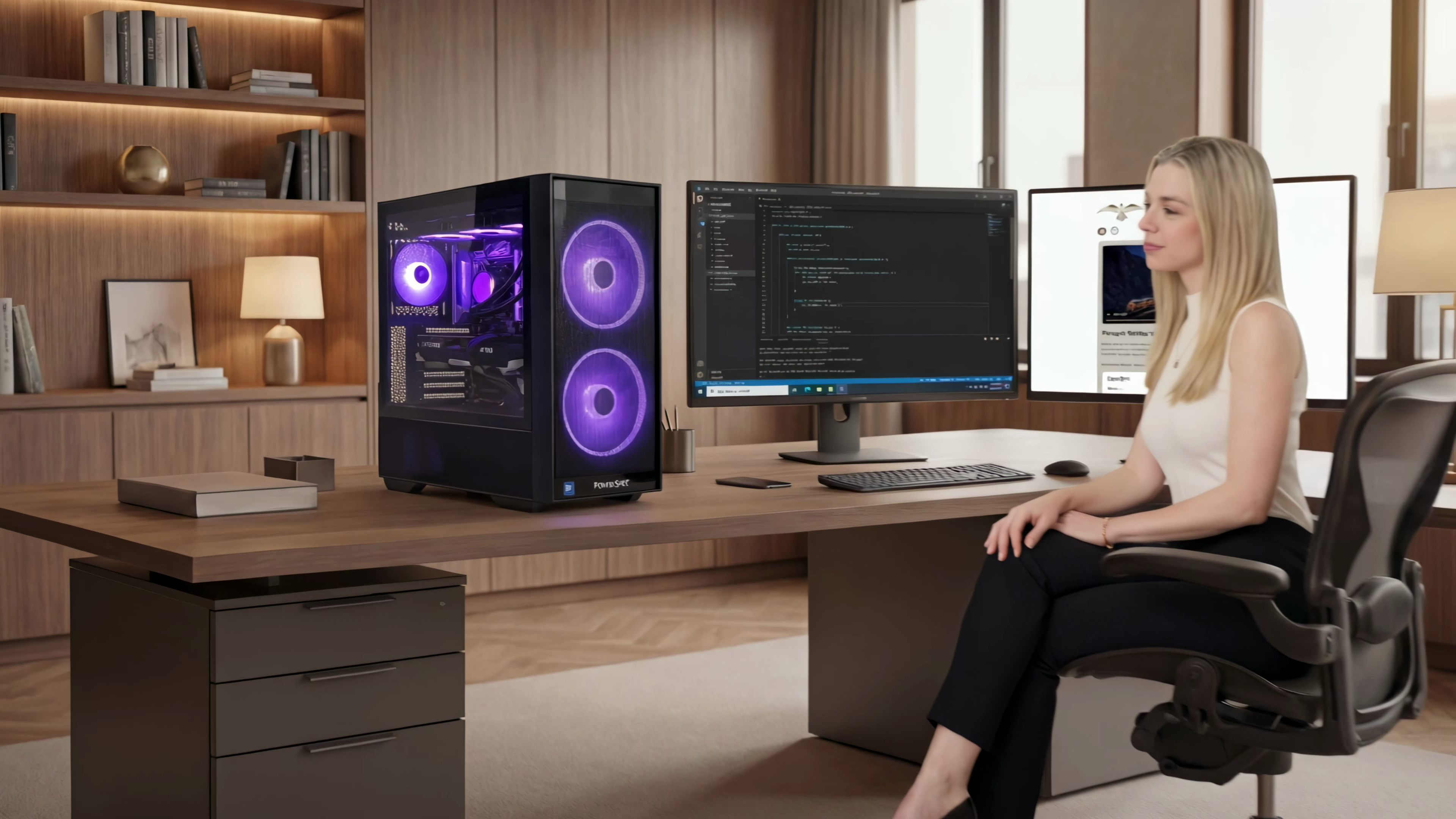
Let’s talk about power.
There is a major disconnect in how many people talk about artificial intelligence. Most conversations focus on prompts, tools, and outputs. People ask what to type, which model to use, or how to make the result look better. Those questions matter, but they are only part of the equation.
The deeper issue is infrastructure.
If you are casually chatting with a bot or generating text through a browser, your personal device may not matter very much. The cloud is doing the heavy lifting. Your laptop, phone, or desktop is mostly acting as the access point.
But the second you move into serious production work — high-fidelity AI video, local rendering, image generation, upscaling, automation, batch processing, or complex creative workflows — your hardware becomes the gatekeeper.
You cannot build at scale if your hardware is your bottleneck.
The AI Conversation Is Too Focused on Prompts
Prompts are important. A strong prompt can improve direction, reduce wasted attempts, and help a model understand what you are trying to create. But prompts alone do not produce a scalable workflow.
In real production environments, the question is not only what did you ask the model to do? The question is also can your system actually handle the work?
That distinction matters because AI output is becoming heavier. Text generation is only one layer. Modern AI workflows increasingly involve high-resolution images, video generation, local model testing, post-production, rendering, upscaling, editing, compression, storage, and publishing.
At that level, AI is not just a prompt box. It becomes a production pipeline.
And production pipelines require power.
Cloud AI Is Useful, But It Does Not Solve Everything
Cloud-based AI tools are excellent for testing, experimentation, and fast access. They allow creators, founders, students, and teams to explore advanced tools without immediately investing in expensive local hardware.
For many people, that is enough.
But for production-ready output, cloud tools can eventually become limiting. You may run into usage caps, queue times, export limitations, inconsistent performance, file-size restrictions, workflow fragmentation, or recurring costs that increase as your output increases.
Cloud tools let you play with the technology. A strong local setup helps you own the workflow.
That difference becomes especially clear when you are building AI media, software tools, digital lessons, marketing assets, or video-based content at a serious pace. Testing a tool is one thing. Shipping polished work consistently is another.
Why Hardware Becomes the Gatekeeper
AI production is resource-intensive because it requires large amounts of computation, memory, storage speed, and processing stability. When one part of the system is weak, the whole workflow slows down.
A local machine with insufficient power may struggle with:
- High-resolution AI video generation
- Video upscaling and enhancement
- Local rendering workflows
- Large image generation batches
- AI-assisted editing pipelines
- Model testing and experimentation
- Large project files
- Fast export and publishing cycles
When the machine cannot keep up, the creator loses time. And in production, time is not abstract. Time affects output, quality, consistency, and the ability to ship.
The Local AI Studio Mindset
For Changing Crowns®, AI is not just something to experiment with. It is part of a broader production environment that includes software engineering, English education, digital lessons, SEO content, real estate marketing, calming tools, and multimedia assets.
That means the workflow has to support more than ideas. It has to support execution.
A local AI studio is not just a powerful computer. It is a production base. It gives the builder more control over performance, files, rendering, iteration, and output quality.
Instead of relying entirely on external platforms, a strong local setup makes it easier to test, refine, generate, edit, export, and publish from one controlled environment.
The Hardware That Matters for AI Production
To support heavier AI and media workflows, I moved to a setup that can actually handle the load.
1. NVIDIA GPU for AI, Rendering, and Video Workflows
A strong NVIDIA GPU is one of the most important components in a modern AI production setup. GPU acceleration matters for AI generation, rendering, video processing, and high-performance creative workflows.
When the work involves visual output, video, image processing, or local AI tools, the GPU is not a luxury. It becomes part of the foundation.
2. 16GB VRAM as a Strong Baseline
VRAM matters because AI media workflows often need to hold large models, frames, textures, and visual data in memory while processing. For high-resolution video, AI upscaling, image generation, and local rendering, limited VRAM can quickly become a bottleneck.
For my workflow, 16GB VRAM provides a strong baseline for more serious AI media production. It gives the system more room to handle complex visual tasks and reduces the friction that comes from constantly running into memory limits.
3. 32GB RAM and NVMe Storage for Smoother Production
AI work is not only about the GPU. System memory and storage speed also matter.
With 32GB RAM, the machine has more room to handle multiple applications, large files, editing software, browser-based tools, local workflows, and production assets at the same time. NVMe storage helps keep data-heavy projects moving faster, especially when working with video files, renders, exports, and high-resolution media.
The result is a smoother production environment with fewer slowdowns and less friction between idea and execution.
Control Is the Real Advantage
The point of stronger hardware is not just speed. It is control.
When your local system can support the workload, you are less dependent on tool limitations, queue timing, browser performance, platform restrictions, or fragmented workflows. You can move faster because the production environment is built to support the work.
That matters for solo founders, AI creators, software engineers, educators, marketers, and independent builders who need to create professional output without waiting on a large team.
More control means more ownership over the workflow.
AI Production Requires More Than Curiosity
Curiosity is where many people start. They test a prompt. They generate an image. They experiment with a video tool. They explore what is possible.
That stage is useful.
But production requires a different level of commitment. It requires systems, repeatable workflows, storage discipline, editing capacity, publishing processes, and hardware that can support the ambition.
One setup lets you play with the technology.
The other lets you own the workflow and ship.
Building With Power, Not Just Prompts
The future of AI will not belong only to the people who know how to write clever prompts. It will also belong to the builders who understand infrastructure.
Prompts may guide the output, but hardware determines how far the workflow can go before it breaks down.
For serious AI production, power matters. GPU performance matters. VRAM matters. RAM matters. Storage speed matters. Local control matters.
If you want to build at a higher level, the question is not only what you can generate. The question is whether your system can support what you are trying to create.
Build with me at https://changingcrowns.com.