
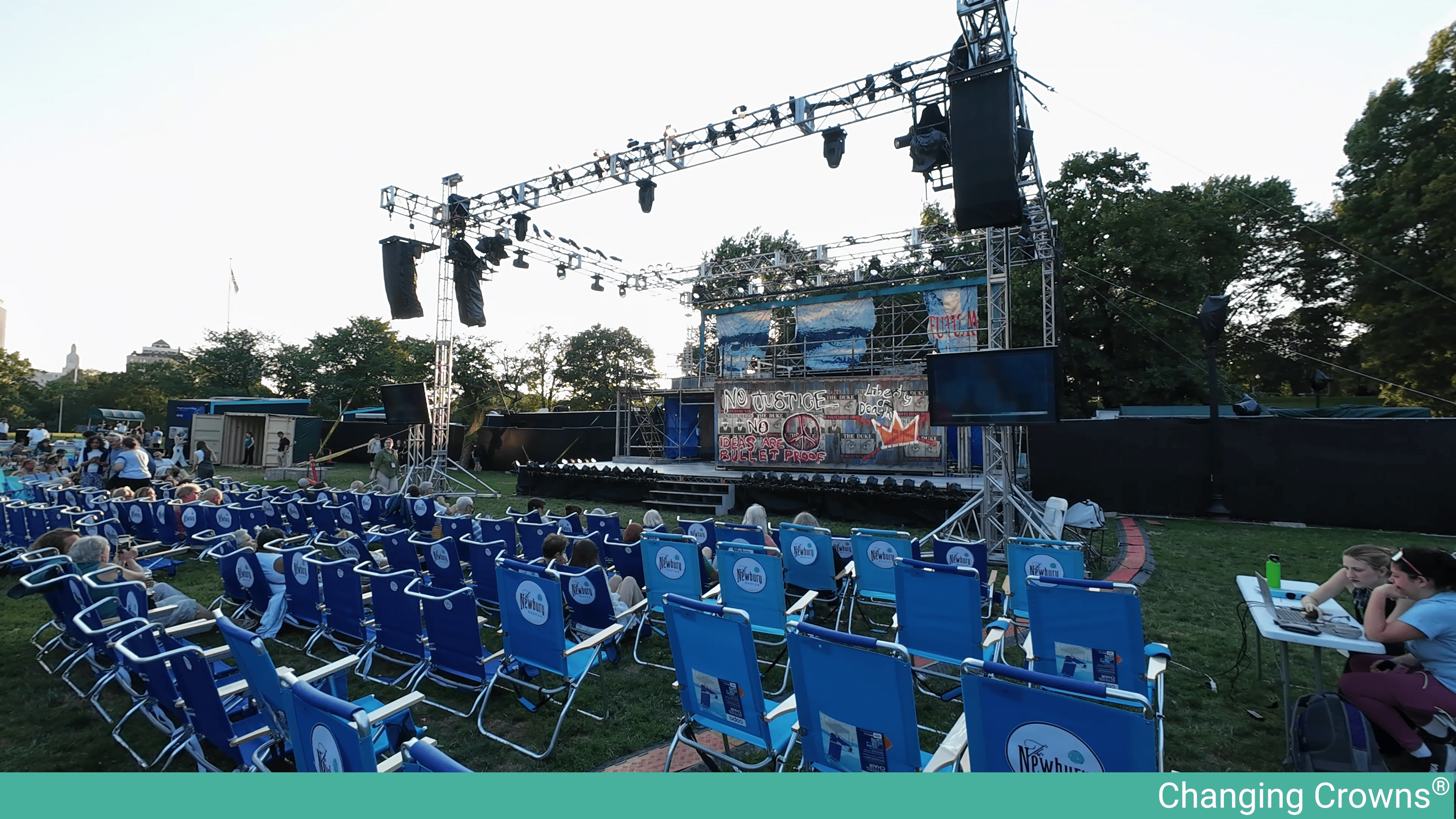
The sun dipped low over Boston Common, casting a golden glow across the grass and turning the leaves a soft, honeyed green. The day’s heat clung to the air, though a faint evening breeze wound its way between the elm trees and across the open lawn. Slowly, the park filled with people — theatre lovers and casual passersby alike — all drawn toward the stage where Shakespeare’s As You Like It would soon unfold.
This review is also an English-learning article. For English learners, live theatre is a powerful way to study descriptive language, literary vocabulary, performance vocabulary, and the kind of expressive sentence structure that makes English feel alive. Shakespeare on the Common offers more than a summer night out in Boston; it offers a real-world language lesson in atmosphere, character, metaphor, humor, and public culture.
Learning English Through a Theatre Review
A theatre review is a useful English format because it combines description, opinion, summary, analysis, and cultural context. It asks the writer to explain what happened, how it felt, why it mattered, and what the audience experienced.
In this article, English learners can study:
- Descriptive vocabulary for setting and atmosphere.
- Theatre vocabulary for performance, staging, and audience response.
- Literary vocabulary connected to Shakespeare and As You Like It.
- Useful phrases for writing about live events.
- Advanced sentence patterns for reflective writing.
Shakespeare on the Common 2025: As You Like It in Boston
In the hour before the performance, the Common had the feel of a festival. Friends shared snacks from tote bags, couples sipped iced coffee, and families wrangled children into place on picnic blankets. A group of college students, dressed in breezy summer clothes, played cards while waiting for the show to start. A man in a Red Sox cap adjusted his folding chair, aiming for the best sightline to the stage. Some in the audience clearly knew the play by heart, their well-thumbed scripts resting on their knees. Others had arrived on a whim, curious to see what free outdoor theatre in the heart of the city could offer.
From my seat near the stage, the view was exquisite. The stage itself, nestled against the backdrop of Boston’s skyline, was dressed in a clever, flexible set design that hinted at both court and forest. Its arches, platforms, and greenery suggested that this was a world where politics and nature would meet, tangle, and transform.
As You Like It, one of Shakespeare’s most beloved comedies, tells the story of Rosalind, her cousin Celia, and a host of lovers, fools, and exiles navigating questions of identity, freedom, and love. It is a tale of mistaken identities, pastoral escapes, and the transformations that happen when characters step away from the rigid order of court life into the playful, unpredictable world of the forest.
Descriptive Language in the Review
The opening paragraphs use sensory language to help the reader imagine the scene. Words and phrases such as golden glow, honeyed green, faint evening breeze, and the feel of a festival create atmosphere before the performance even begins.
This is an important writing technique. Strong reviews do not only tell readers what happened. They help readers feel as if they were there.
The Performance: Energy, Humor, and Audience Connection
From the moment the actors took the stage, the energy was palpable. Rosalind’s first entrance was met with eager applause, and her voice rang out with warmth and clarity, instantly winning the crowd. Celia matched her with quick wit and charm, their banter both intimate and razor-sharp. Orlando, the young hero, arrived with a mix of youthful bravado and vulnerability that made his later romantic fumblings all the more endearing.
One of the joys of Shakespeare on the Common is the way the city itself becomes part of the performance. As characters fled to the Forest of Arden, the rustle of leaves in the actual Boston Common trees became a natural soundtrack. In one of the play’s quieter moments, a faint siren in the distance and the laughter of children on the periphery blended into the scene, reminding us that this was not an isolated theatre. It was a living, breathing corner of the city, layered with real life.
The Commonwealth Shakespeare Company’s production brought color and movement to every moment. Costumes were a feast for the eyes: jewel-toned gowns that shimmered under the stage lights, textured vests and tunics that seemed to carry the dust of the forest, playful hats and accessories that hinted at the characters’ personalities. The lighting shifted seamlessly from the warm golds of the court to the cool, verdant hues of the forest, deepening the contrast between the two worlds.
And then there was the comedy — delivered with a freshness that made centuries-old jokes land like new. Touchstone, the court jester, was a whirlwind of physical humor and sly wordplay, his asides drawing belly laughs from the crowd. Jaques, the melancholy philosopher, brought a slower rhythm and a reflective tone, particularly in the famous “All the world’s a stage” speech. Here, the actor’s delivery was deliberate, almost conversational, pulling the audience into a shared moment of quiet recognition before the pace picked up again.
Theatre and Literature Vocabulary Table
Use this vocabulary table to study words and phrases from the review. These terms are useful for English learners who want to write about theatre, literature, public events, and live performance.
Useful Phrases for Writing a Theatre Review
English learners can use these phrases to write about plays, concerts, public events, and performances.
- The production brought... color, movement, humor, and emotional depth to the stage.
- The audience responded with... laughter, applause, attention, and warmth.
- The set design suggested... a world between court and forest.
- The actor’s delivery was... deliberate, expressive, conversational, or energetic.
- The performance felt... joyful, intimate, timely, polished, or deeply human.
- The final scene left the audience... lighter, moved, thoughtful, or energized.
Literary Themes in As You Like It
As the story moved deeper into the forest, the play’s themes came into sharper focus. Disguise and transformation were everywhere — in gender-swapped roles, in characters finding courage they did not know they had, and in love blooming in unexpected places.
Watching under the open sky, it was impossible not to think about the ways people are shaped by the spaces they inhabit. The Forest of Arden became more than just a setting. It became a metaphor for the freedom to explore identity without the pressures of everyday life.
For English learners, this is a helpful way to study literature: identify the plot, then look for the deeper themes. In As You Like It, important themes include:
- Identity: who people are and how they present themselves.
- Disguise: the use of changed appearance or role to reveal truth.
- Freedom: the contrast between the rules of the court and the openness of the forest.
- Love: romantic, familial, and social connection.
- Community: the way people gather, change, and resolve conflict together.
Why Outdoor Theatre Makes the Language Feel Alive
The audience responded with warmth and attentiveness. They laughed in unison at the play’s more outrageous moments — Orlando’s lovesick poetry, Touchstone’s verbal gymnastics — and leaned forward during its tender scenes. Children, usually restless after sunset, sat surprisingly still, eyes fixed on the action. Older couples exchanged knowing smiles at Shakespeare’s reflections on love and time.
In the final act, as disguises were dropped and truths revealed, the stage pulsed with joy. Music swelled, characters embraced, and the world of the play shifted from confusion to harmony. It was the kind of ending that leaves you lighter than you were when you arrived — a reminder that, at least in comedy, resolution, unity, and joy are possible.
What struck me most was how As You Like It felt in 2025. In an era marked by constant motion, digital overload, and the narrowing of public spaces, this night in the Common was a reminder of the power of gathering in person, without screens, for a shared artistic experience. Strangers sat shoulder to shoulder, reacting together in real time. The play’s invitation to step into another world, play with identity, and find love in unlikely places felt more than relevant. It felt necessary.
Practice: Write Your Own Short Review
Use these questions to practice writing about a live event in English:
- Where did the event take place?
- What did the setting look, sound, and feel like?
- Who was in the audience?
- What part of the performance felt most memorable?
- What vocabulary would you use to describe the mood?
- What larger idea or theme did the event make you think about?
Try writing five to seven sentences using at least three words from the vocabulary table.
Highlights Reel
Boston, Shakespeare, and Shared Language
There is a generosity to Shakespeare on the Common that cannot be overstated. Free theatre, professionally staged, offered in the heart of the city, says something about what Boston values. It says art belongs to everyone. It says stories from four centuries ago still have something to teach us. And it says that sometimes, the best stage is not behind closed doors, but under the shifting sky.
As the cast took their bows, the applause was thunderous. People stood, clapped, and cheered, some whistling, others simply smiling in a way that seemed to say, “Yes. This mattered.” The actors waved, the lights dimmed, and slowly, the audience began to drift back into the city night.
Walking away from the stage, I glanced back one last time. The set stood empty but still alive with the echoes of voices, the shimmer of costumes, and the ripple of laughter. Around me, people were already discussing their favorite moments, quoting lines, and making plans to return for another performance before the run ended.
To the Commonwealth Shakespeare Company: thank you for bringing As You Like It to life with such heart, humor, and craft. Boston is lucky to have this tradition, and I am grateful to have been there — not just as an audience member, but as part of a living, breathing celebration of theatre.
Learn more or support the production at commshakes.org.
Learn English with Changing Crowns®
Changing Crowns® creates English learning resources that connect vocabulary, grammar, meaning, literature, and real-world culture. Learners build stronger English when they study language in context — through stories, public events, reviews, examples, and thoughtful explanations.
Explore English articles, vocabulary guides, and learning resources at changingcrowns.com.
Quick Summary
Shakespeare on the Common 2025 offered a joyful Boston performance of As You Like It and a rich opportunity for English learners to study theatre vocabulary, descriptive language, literary themes, and review writing. By turning a cultural review into a language-learning resource, learners can practice advanced vocabulary while exploring Shakespeare, public art, and live performance in context.