
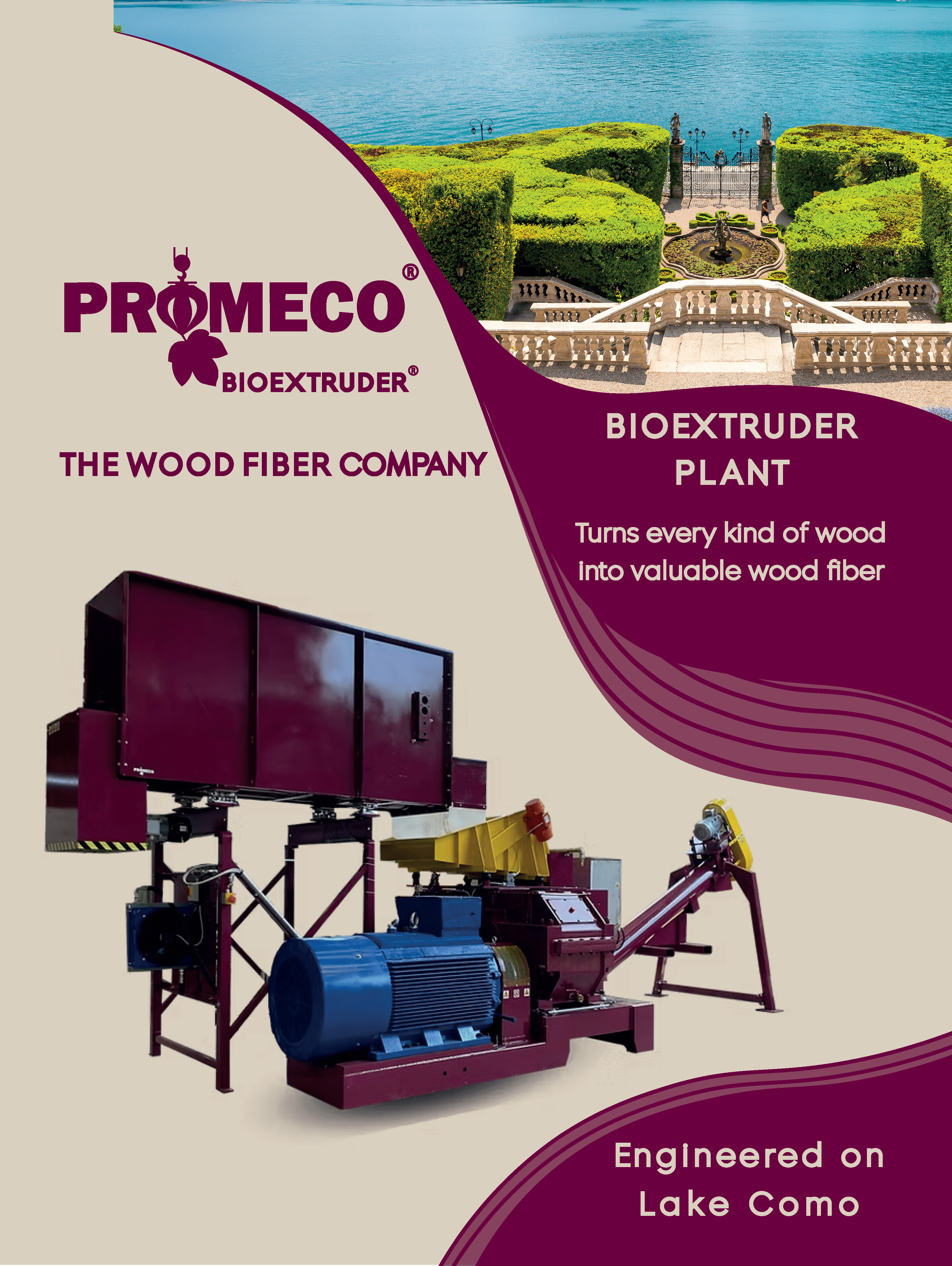
The Innovation — The Bioextruder: Learning, Technology, and Impact
Every major shift in industrial sustainability begins with a single breakthrough technology. For Promeco Bioextruder® S.r.l., that breakthrough is the Bioextruder® — a patented, mechanical-thermal process that redefines how wood and other lignocellulosic materials are transformed into renewable fiber.
Unlike conventional shredding or refining, the Bioextruder uses steam-explosion extrusion, a clean-technology method that relies on mechanical pressure and internal friction to heat material to approximately 125 °C. This generates controlled steam within the feedstock, which then expands and separates the wood’s internal structure when released. The result is an expanded, porous, pathogen-free fiber — produced entirely without chemical additives or binders. This is the famous steam explosion.
The technology is grounded in mechanical fiberization, a discipline that converts solid biomass into structurally open, absorbent material suitable for use in sustainable horticultural substrates. By combining thermal and mechanical forces in a single, compact operation, the Bioextruder achieves efficiencies that traditional multi-stage systems cannot match. Its automatic operation, low OPEX (operating expenditure ≈ 6 kWh m³), and maintenance-light design make it ideal for industrial environments seeking reliability and continuous output. With a nominal capacity of up to 40 m³ h⁻¹ EN 12580, it provides the performance required for large-scale fiber production while maintaining the footprint of a single modular unit. The break even point is considered at about 5000 mc/y.
Because of its multi-application potential, the Bioextruder can process a wide spectrum of woody and lignocellulosic feedstocks — including virgin wood, compost oversize, forestry by-products, and recycled timber. In the wood-fiber sector, it represents the core transformation that turns biomass into sustainable, peat-free substrates.
Manufacturers who already operate substrate-blending or bagging lines can also integrate the Bioextruder as a drop-in upgrade, expanding their production capabilities without a complete rebuild. This flexibility has made it an attractive option for existing producers upgrading their lines as well as new entrants seeking compact, low-energy solutions for decentralized operations.
Technically, the Bioextruder represents an Italian interpretation of industrial simplicity: a single machine performing a complex transformation through precise control of mechanical, thermal, and steam-pressure dynamics. Strategically, it places Promeco at the intersection of clean technology, materials science, and the circular bioeconomy — a market segment that rewards measurable reductions in carbon, water, and waste.
In the broader narrative of sustainable industry, the Bioextruder stands as a symbol of how mechanical innovation can achieve environmental impact without relying on chemicals. It demonstrates that engineering excellence and ecological responsibility are no longer opposing goals but parts of the same industrial logic: turning local biomass into global climate solutions.
Learn more about the Bioextruder technology at www.bioextruder.it
Verified Sustainability
Sustainability is no longer a slogan—it’s a metric. To separate fact from greenwashing, Promeco commissioned an independent environmental study by a third-party evaluation, a specialized consultancy in carbon- and water-footprint verification. The results, developed under ISO 14067 (Carbon Footprint of Products) and ISO 14046 (Water Footprint), confirm that the Promeco wood fiber process achieves record-low impact across all key environmental categories.
| Material | Carbon Footprint (kg CO₂e t⁻¹) | Water Footprint (m³ H₂O t⁻¹) |
|---|---|---|
| Peat | 1,208 | 9,000 |
| Coir | 361 | 2,449 |
| Compost | 113 – 484 | < 100 |
| Promeco Wood Fiber | 188 | 0.13 |
Promeco’s technology delivers approximately six times less carbon and seventy thousand times less water consumption than traditional peat. It accomplishes this through a closed mechanical-thermal process that uses only steam and friction—no chemicals, no effluent, no wastewater. The process is energy-efficient, relying on modest electrical power and self-generated thermal energy within the extrusion stage.
Water Integrity: Near-Zero Blue and Grey Impact
The Bioextruder's process achieves near-zero blue and grey water footprints. It releases no polluted effluent—an advantage that distinguishes it from biological or chemical treatment technologies still common in the market. This adds quantitative strength to the claim of a “clean mechanical process.”
The Solution — Turnkey Bioextruder Wood Fiber Production Plants
If the Bioextruder is the heart of the process, the turnkey wood fiber plant is the living body that carries it into industry. Designed and delivered by Promeco Bioextruder S.r.l., these complete, ready-to-operate systems translate Promeco’s patented mechanical-thermal innovation into scalable production for the global horticultural and substrate sectors.
One Core Technology
Promeco offers two optimized Bioextruder wood fiber production plants, each engineered for a specific feedstock stream:
- From Compost Oversize / Recycled Wood
- Input: oversize from composting plant, timber from treatment platforms, recycled lignocellulosic waste
- Output: light, porous wood fiber serving as a high-performance peat substitute
- Advantages: sanitized fiber, uniform particle size, low bulk density for blending and bagging
- From Fresh Wood Chips
- Input: virgin wood chips (30–150 mm) — yellow pine for the US, pine for the EU, and spruce for the UK
- Output: premium-grade fiber for topsoils, universal substrates, and hydroseeding applications
- Advantages: excellent porosity, high rewettability, long-term structural stability
In both systems, the Bioextruder performs the central steam-explosion extrusion step that opens the wood’s structure, eliminates pathogens, and creates hygienized, plant-ready fiber. Pre-treatment steps—screening, shredding, cleaning, dosing, and conveying—are included only as needed, ensuring compact layouts and efficient CAPEX.
Performance and Process Efficiency
Each turnkey line is designed for industrial reliability and low environmental impact:
- Throughput ≈ 4 t h⁻¹ (≈ 40 m³ h⁻¹ volume)
- Energy consumption ≈ 6 kWh m⁻³
- Automatic operation with minimal staff oversight
- CE-marked for EU mechanical conformity and UL/OSHA-compliant for US safety
- Low OPEX (average ≈ €6 m³ including preventive maintenance)
Each plant is configured for local biomass availability—spruce in the UK, yellow pine in the US, and pine in continental Europe—reinforcing a distributed production model that minimizes logistics costs and carbon leakage.
Horticultural Performance and Peat Replacement
Promeco’s Bioextruder's wood fiber plants supply a stable, year-round product independent of climate or harvest cycles. The resulting fiber can replace up to 70% of peat in substrate blends while enhancing physical performance:
- Reduced specific weight (lightens mixes)
- Optimized drainage and aeration for root growth
- Improved rewettability and water holding
- Weed-free and pathogen-free composition
As verified in the third-party study, this substitution achieves dramatic reductions in CO₂ and water footprint, positioning Promeco’s systems as the most environmentally efficient choice for sustainable horticulture substrates in Europe and North America.
Global Installations and References
Promeco’s turnkey plants are already in operation across twelve countries:
- United Kingdom – Annan (3 lines), Peterborough (ICL)
- France – Onesse-et-Laharie (Agaris)
- Germany – Hallertau
- Czech Republic – Borkovice, Česká Skalice
- Poland – Rucianka | Slovakia – Vel’ké Dravce
- Austria – Tenneck | Ireland – Donegal, Dungannon
- Spain – Valencia | Italy – Calvisano (2 lines), Sannazzaro De’ Burgondi (2 lines)
- United States – Jacksonville (Timber Fiber), Georgia and Virginia under construction
- Japan – project under construction
Each installation demonstrates Promeco’s ability to tailor plant design to local feedstock, regulatory standards, and production goals, ensuring consistent quality across climates and regions.
Delivery and Support Model
Promeco Bioextruder S.r.l. delivers its systems on a turnkey EPC basis—engineering, procurement, construction, commissioning, and operator training—all managed through a single technical interface. Typical lead time is six months, with modular components shipped in 40-ft standard containers for simplified logistics and rapid on-site assembly. After commissioning, Promeco provides ongoing after-sales service, maintenance programs, and remote technical support, ensuring lifetime system performance.
A Distributed Model for a Circular Economy
Rather than centralizing production in massive facilities, Promeco’s compact wood fiber plants enable decentralized manufacturing hubs (multiple smaller production plants) close to feedstock sources and end users. This approach reduces transport emissions, keeps value in local communities, and supports rural employment within the EU’s circular bioeconomy framework. It is a model where technology meets territory — sustainability that is both measurable and livable.
The Authority — Promeco: Experience, Vision, and Contact
Behind every innovation that reshapes an industry is a company with the courage to engineer differently. Since 1996, Promeco S.p.A. has combined mechanical precision with environmental intelligence, developing patented systems that bridge industrial recycling, energy recovery, and circular manufacturing. From its headquarters in Como, Italy, Promeco has built a reputation for Italian engineering excellence — where reliability, performance, and sustainability converge.
Today, Promeco’s name is synonymous with industrial solutions for a circular bioeconomy. Its technologies are installed on five continents, serving partners who demand more than equipment — they seek measurable, certifiable impact. Each plant or machine is designed with the same philosophy: transform residual material into a new resource through processes that are efficient, replicable, and verifiably clean.
At the center of this mission stands the Bioextruder Wood Fiber Production Plant, the flagship system commercialized by Promeco Bioextruder S.r.l. This dedicated entity represents the group’s horticulture and substrate division, specializing in the design and delivery of turnkey wood fiber plants for peat-free growing media. It acts as Promeco’s global channel for clients in Europe, the UK, and North America seeking to implement full-scale, sustainable fiber-production lines.
What distinguishes Promeco is its ability to integrate decades of mechanical innovation with the demands of modern climate policy. Its engineering standards meet CE marking for the EU, UL certification for North America, and OSHA-compliant workplace safety requirements — ensuring that every plant operates under the highest levels of technical and regulatory conformity. Beyond compliance, Promeco’s commitment to transparency and independent verification aligns directly with EU Green Deal, ISO 14040/44, and ESG reporting frameworks.
Across nearly three decades, Promeco has evolved from a national manufacturer into a global partner for sustainable industry, collaborating with organizations such as ICL, Agaris, and Timber Fiber to redefine how raw materials become climate-positive products. Each collaboration demonstrates the same principle: progress begins when technology serves both profit and planet.
For clients and partners ready to explore the next generation of sustainable substrate production, Promeco offers more than machinery — it offers a proven path to measurable decarbonization and long-term operational resilience.
Contact Promeco
Websites:
www.promeco.it – Corporate and engineering solutions
www.bioextruder.it – Wood fiber and peat-free technology
Email: [email protected]
Phone: +39 031 267331
Book a technical consultation or request a wood fiber plant review to discover how Promeco’s Bioextruder technology can transform local feedstock into global sustainability value: www.promeco.it/contatti
The Future of Peat-Free Horticulture
The next decade will redefine what it means to grow responsibly. Across Europe, the United Kingdom, and North America, policymakers are phasing out peat use in professional and consumer substrates — not as a trend, but as a necessity. The European Union’s 2050 climate targets, the UK’s peat-ban roadmap, and state-level carbon policies in the US are converging on one clear requirement: replace extraction with regeneration.
This shift demands technologies that do more than comply — they must scale, replicate, and verify results. That is where Promeco’s Bioextruder wood fiber technology becomes the bridge between environmental ambition and industrial feasibility. By transforming regionally available pine, spruce, and recycled wood into consistent horticultural substrates, turnkey wood fiber plants can localize supply chains, cut transport emissions, and give growers independence from imported peat or coir.
Analysts estimate that converting just 30 to 60 plants across Europe could replace Italy’s entire annual peat consumption. Each installation becomes part of a distributed network of sustainable substrate producers, turning low-value biomass into high-value peat substitutes. The economic ripple extends far beyond horticulture — stimulating forestry by-product markets, job creation in rural areas, and measurable CO₂ reduction under verified circular bioeconomy frameworks.
Promeco envisions a future where environmental compliance is no longer a burden but a growth strategy. Its European green innovation aligns technological progress with ecological integrity — proving that industrial manufacturing can heal rather than harm. For growers, investors, and policymakers alike, the message is simple: the future of peat-free horticulture is already here, built one Bioextruder plant at a time.
About This Advertorial on Changing Crowns®
This technical advertorial was produced by Changing Crowns®, a Boston-based software and SEO content company that publishes long-form, search-optimized articles for global brands in technology, sustainability, and industrial innovation.
To learn more about SEO-optimized advertorials on Changing Crowns®, visit our overview page on results-driven advertorials and content placement: https://changingcrowns.com/advertorials/